Sophocles’ Electra at Poreia Theatre examines questions of injustice and power

How relevant is Greek mythology to the moral dilemmas we face today? In Tarlow’s powerful staging of Electra at the Poreia Theatre, the play attempts to answer questions posed by Sophocles on revenge, the pursuit of justice and the ensuing circle of violence and loss. The question is as relevant today as it was in Classical Athens. Text by: Nina Papathanasopoulou, Sophie Okite, Alex Piteris, and Olivia Stacey
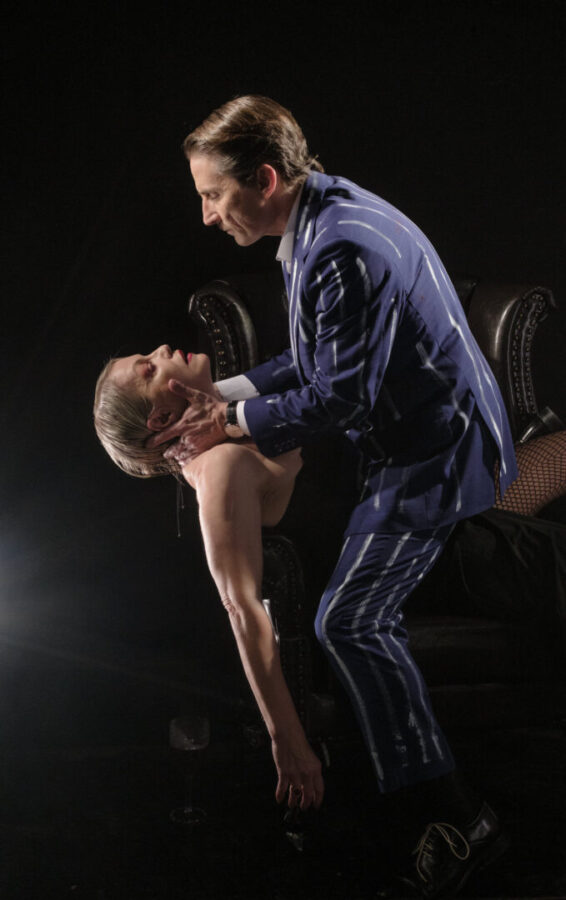
Dimitris Tarlow’s interpretation of Sophocles’ Electra focuses on the psychological and emotional turmoil of Electra, a woman haunted by the past and paralyzed by grief. Returning home from the Trojan War, her father Agamemnon was killed by his wife and Electra’s mother Clytemnestra, together with the help of Clytemnestra’s new lover, the usurper Aegisthus. The two of them are now in charge and ruling the palace, while Orestes, Agamemnon’s and Clytemnestra’s only son, is in exile. Electra refuses to accept her father’s death. She mourns him constantly and is unable to move on past her sorrow. Her grief, however, fuels her commitment to avenging her father’s death and achieving what she considers justice by killing his murderers, her own mother and Aegisthus.
Scene from Sophocles’ Electra© Patroklos Skafidas
How do we react to Electra’s desire for justice and revenge? Do we admire a woman who is so determined and unyielding or do we see her behavior as destructive, both for herself and those around her? To explore Electra’s character, Sophocles juxtaposes her with other women — Clytemnestra, Chrysothemis, and the chorus of Mycenaean women — each of whom responds differently to loss, injustice, and powerlessness. Clytemnestra cannot let go of her murdered daughter Iphigeneia; Electra cannot let go of her murdered father Agamemnon; Chrysothemis has chosen acceptance and survival even when she knows the situation is unjust. The play presents grief and its management both as a private psychological problem and as a profoundly political and ethical one: how should we respond to injustice? Do we accept or resist the power of those who wrong us? Does our determination to remember and avenge the past liberate us or destroy us? Sophocles’ Electra resonates across time because it deals with universal human experiences of grief, loss, and the difficulty of accepting death and injustice — concerns that are still relevant in a modern world where, on the one hand, death is sanitized and distanced from everyday life and, on the other, wars and autocratic regimes make death a frequent, common, yet terrifying occurrence.
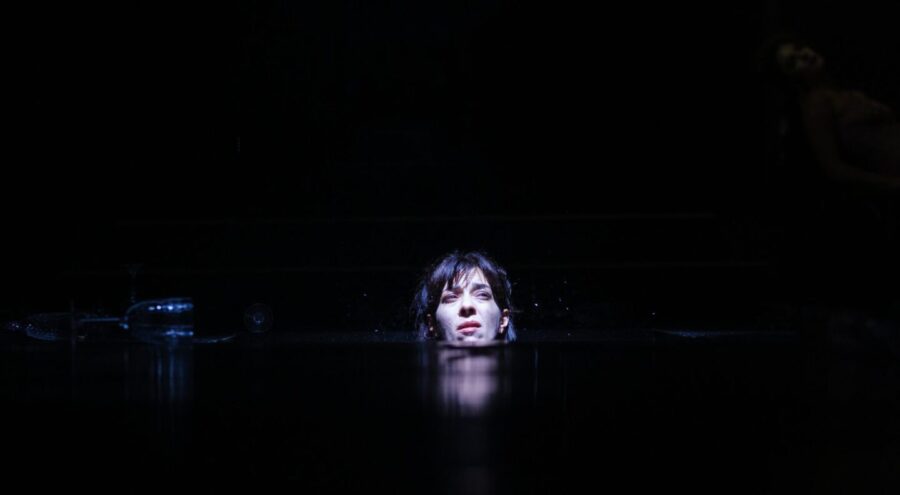
Tarlow sets the play in the aftermath of a cabaret party with Electra standing out from the rest of the characters by spending a large amount of time in a pit beneath the stage floor, whose two sliding doors leave a hole open through which her head is visible. From this underground prison-like space she mourns and laments while droplets of water often fall directly on her face yet nowhere else onstage. The raindrops seem to magnify her tears, making her continual weeping more pronounced. Electra’s physical entrapment reflects her emotional confinement and makes all the more evident her inability to move on. As Tarlow himself noted in a Q&A after the play, the staging is intended to recall Samuel Beckett’s Happy Days, in which Winnie is embedded up to her waist in a mound of earth, immobilized, yet still able to speak, her voice being the main instrument of her resistance. Like Winnie, Sophocles’ Electra is a figure confined and trapped; her voice, however, cannot be silenced and her constant laments remind everyone of the injustice incurred.
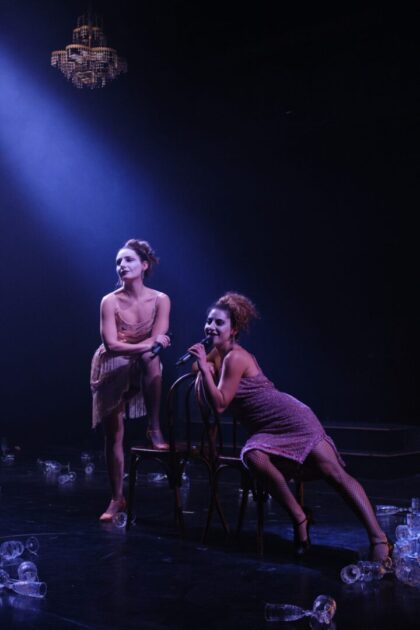 The costumes utilized in the performance support the director’s vision for a 1920s, Cabaret aesthetic. Faces painted white, with dark eyeliner, and vibrant lipstick create a stylized atmosphere allowing for a suspension of reality. Electra’s black clothing – a long black leather coat, pants, and flat black shoes – affirm her deep state of mourning and distinguish her from the other female characters in their sensual dresses, shorts, and high heels. Clytemnestra’s long crimson velvet coat is in stark contrast to Electra’s, drawing attention to the queen’s sensuality, the color juxtaposing the themes of love and violence that she wrestles with continually during the performance. The lighting similarly reflects the emotional journeys of the characters while also setting the overall tone of the story. Most of the performance is cast in darkness, with sporadic light fixtures or spotlights illuminating specific moments. The use of darkness keeps audience members in suspense and tensions high throughout. A particularly noteworthy lighting choice was the use of an orange glow, bathing the stage during the two prayers to Lycian Apollo performed by Clytemnestra and Electra, respectively. Lighting choices such as these highlight the similarities between mother and daughter, especially their shared fixation on the past and eagerness for revenge. The modern aesthetic of both the costumes and lighting help the audience relate to the tragedy, enhancing rather than distancing its emotional and ethical tensions.
This modern aesthetic extends beyond costume and lighting to the production’s striking reimagining of the Chorus. In the early stages of Greek tragedy, the Chorus typically consisted of twelve members, a number Sophocles later increased to fifteen. They performed song and dance to musical accompaniment, remained on stage throughout the play, and reacted continuously to the unfolding action. Modern stagings take various approaches in staging the Chorus: should its lines be sung, spoken, or chanted? Tarlow opts for a combination of all three. Unlike the large choruses of the past, this Electra includes only two Chorus members: two young women of the cabaret, dressed in flapper dresses and performing into microphones. They are accompanied by two live musicians who remain on stage throughout the play, a string player and Pylades on the keyboard. Together, they sing and dance to music that is jazzy and contemporary, at times delivering lines from the original play in Greek and at others performing songs in English. This approach offers a fresh response to the challenge of staging the Chorus, incorporating musical and dance elements that recall its original function while giving it a distinctly modern form. Like a traditional Greek chorus, they remain on stage from the opening scene to the final moments, continuously reacting to the action.
Sophocles invites us to explore Electra’s character and views on justice further through her interaction with her younger sister, Chrysothemis. Chrysothemis’ more measured emotional response to their father’s murder and mother’s new rule highlights Electra’s level of distress. Tarlow makes bold use of the costumes to make this contrast immediately visible. Chrysothemis first appears on stage during the musical prelude strutting across the stage in ripped fishnet tights, a revealing sparkly bodysuit, and a dramatic white fur coat. Smoking a cigarette and playfully interacting with the band, she projects ease and performative confidence. In contrast to Electra’s black trench coat signalling mourning and fixation, Chrysothemis’ sparkly costume evokes a desire for freedom and pleasure, and distinguishes her from her grieving sister.
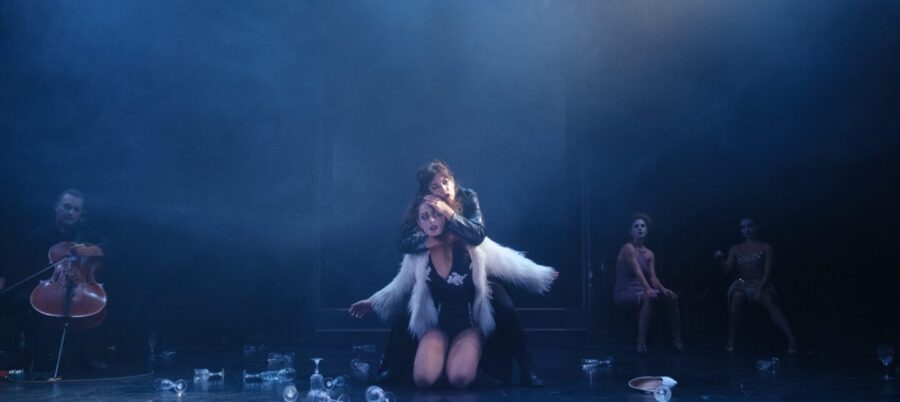
 As the play progresses, however, Chrysothemis reconsiders her views on justice and freedom. In the scene where Electra urges her to join in revenge, the staging becomes intensely physical: the two actors lie entangled with Electra pressing onto Chrysothemis, creating an unsettling intimacy. The layering of costumes becomes symbolic here: Electra’s black coat envelops Chrysothemis’ glittering bodysuit, suggesting that the family’s grief and violent legacy threaten to overwhelm her desire for autonomy. The image is striking with Electra pressing down on her sister, as if wanting to drag her into the same pit of mourning and obsession from which she herself cannot escape.
Clytemnestra has a commanding presence in this production, presented as a queen who is powerful, self-assured, and unapologetic. Her argument — that Agamemnon’s sacrifice of their daughter Iphigeneia justified her revenge — is presented with conviction and clarity, and at moments the audience may find themselves persuaded by her perspective. Yet the staging seems to undermine the strength of her argument. In her confrontation with Electra, Clytemnestra is frequently ironic and dismissive, and her scorn for her daughter’s grief even edges into mockery. This choice somewhat undermines the sympathy she might otherwise garner: a Clytemnestra who engages with Electra’s pain more seriously, rather than laughing it off, could have made her case feel truly tragic and forced the audience into a more uncomfortable moral reckoning. As it stands, Clytemnestra’s arrogance keeps us at a distance, and the production misses an opportunity to leave the audience genuinely torn between mother and daughter.
One of the most powerful moments of the production comes with the false report of Orestes’ death. When the Tutor narrates, in vivid and persuasive detail, the story of Orestes’ death, Electra believes him, and a box said to contain his ashes is brought on stage. As Pylades reluctantly hands her the urn, she grips his hand and smiles before opening it and dipping her hands inside. She then smears the ashes across her face, marking her grief visibly and bodily. Rising, she walks forward and addresses the audience directly: “Would you like to stand?” She waits in silence until the audience obeys, and as they rise, she delivers her lament over what she believes to be her brother’s remains. Loukia Michalopoulou’s delivery throughout this scene is remarkable: her lament is raw and utterly convincing, capturing a woman completely alone, stripped of the one person she believed would return as her savior to restore justice. The moment is deeply moving, drawing the audience into her mourning. At the same time, Orestes watches from a distance, visibly shaken by her suffering. At the end of her speech, he lunges toward her as if to embrace and comfort her, but is restrained by Pylades, who recognizes the danger of revealing himself too soon. The tension culminates in Orestes’ eventual disclosure of his identity, and the recognition scene that follows is one of the most emotionally charged moments of the performance. The siblings lie on the ground, Orestes on top of Electra, mirroring the earlier entanglement of Electra and Chrysothemis but now charged with joy rather than dread. Orestes breaks into song, a way to project his overwhelming emotion and to highlight the enduring love between the two siblings.
 The ending of the play illuminates the relationship between Orestes and Electra and draws a parallel between that of Orestes and his father Agamemnon. Having killed Clytemnestra, Orestes awaits Aegisthus, who enters triumphantly only to realize that his doom is near. Orestes forces him into the palace and the play ends in anticipation of his murder. As he leads him inside, Orestes does not spare a glance toward Electra. His focus is fixed entirely on his objective, the killing of Aegisthus and the reclaiming of his birthright. In a striking visual detail, however, he speaks into the microphone that Aegisthus had used earlier, a clear image of the transfer of power from Aegisthus to Orestes, hinting to a continuation of the tyranny rather than its conclusion. Meanwhile Electra does not follow him into the palace. Instead she descends back into her pit, closing its gate around her neck while smiling. It is a deeply unsettling image: revenge has been achieved, yet she remains exactly where she began. As actor Konstantinos Zografos (Orestes) noted in a discussion with us after the play, Orestes kills not as a savior but out of obligation, much as Agamemnon was compelled to sacrifice his own daughter by the goddess Artemis. Power transfers, but the cycle of violence seems to continue with the effects of loss still present and debilitating.
Does the Poreia production offer answers to the questions posed by Sophocles’ play? At first, it seems to invite admiration for Electra’s unwavering commitment to resistance and justice. Yet when Electra finally completes her revenge she returns to her pit, as if still bound to the grief and stubbornness that have defined her throughout. In Tarlow’s powerful staging, revenge offers no resolution; it fails to bring the transformation or release she had seemed to be seeking. Nor does Orestes emerge as the savior Electra had imagined. The production thus sharpens the ethical tensions at the heart of Sophocles’ play. If revenge and the pursuit of justice lead here, the play seems to ask was it ever worth it? And if the answer is no, what is the alternative? The question is as relevant today as it was in Classical Athens.
Poreia Theatre, Trikorfon St, Victoria Sq, Athens 10443
Until April 5
Nina Papathanasopoulou (PhD, Columbia University) is a Professor of Classical Studies at College Year in Athens specializing in Greek drama and mythology. Sophie Okite (Macalester College), Alex Piteris (Muhlenberg College), and Olivia Stacey (Brown University) are students studying at College Year in Athens in Spring 2026 and taking Papathanasopoulou’s course on “Ancient Greek Mythology and Religion.”